
Colorado County Court Records After Arrest
The arrest-to-court path in Colorado County starts with booking at the county jail or another lawful custody point, then moves to a magistrate appearance and prosecutor review. The local prosecutor page names Jay E. Johannes as the Colorado County Attorney, with the office at the courthouse in Columbus. Research also identified the office as the local prosecutor contact for charge decisions, although exact jurisdiction labels should be read with care because county materials are brief. The key point for court records after a jail arrest is simple: the jail booking is not the same record as the criminal case.
A booking record may show the arresting agency's first listed offense. A court record shows what the prosecutor files and what the court does with it. That distinction matters when an offense is declined, amended, reduced, added, or dismissed after review. For current custody and booking details, use the Colorado County jail inmate records path. For booking photos, use the Colorado County jail mugshots page. Court records after a jail arrest belong in the clerk and court systems once a case exists.
Find Colorado County Court Records After Arrest
The Colorado County Clerk links criminal court records to the Texas UCMS Public Access Portal. The public portal offers Tyler Odyssey Smart Search and Search Hearings. Smart Search is the better starting point for charges after a jail arrest because it can search by record number or by name in Last, First Middle Suffix format. The advanced panel adds filters for location, search type, case type, case status, file dates, judicial officer, judgments, and warrants.
The official Colorado County Clerk page also links civil and probate records to ResearchTX and county clerk records to a Tyler records public-access portal. Those links do not replace the criminal case search. The District Clerk says public search terminals are available in the District Clerk's Office during regular business hours, and copies may be purchased for $1.00 per page. Older, restricted, sealed, or not-online court records may require that in-person clerk route.
- Start with the jail or arresting agency if the arrest is very recent, because court records may not exist yet.
- Open the County Clerk's Tyler Odyssey link for criminal court records after a filing is likely.
- Search by record number when known, or use the defendant name format shown by Smart Search.
- Use advanced filters to narrow by location, case type, case status, filed date, judicial officer, or warrant status.
- Use Search Hearings when a case has appeared and the next court date needs confirmation.
The County Clerk page warns that clerk staff do not perform unauthorized searches and cites Attorney General Opinion WW-607. That means a public user should search the portal, use available public terminals, or request copies by enough case detail for staff to locate the record.
The Texas UCMS Public Access Portal is the official doorway Colorado County links for criminal cases.
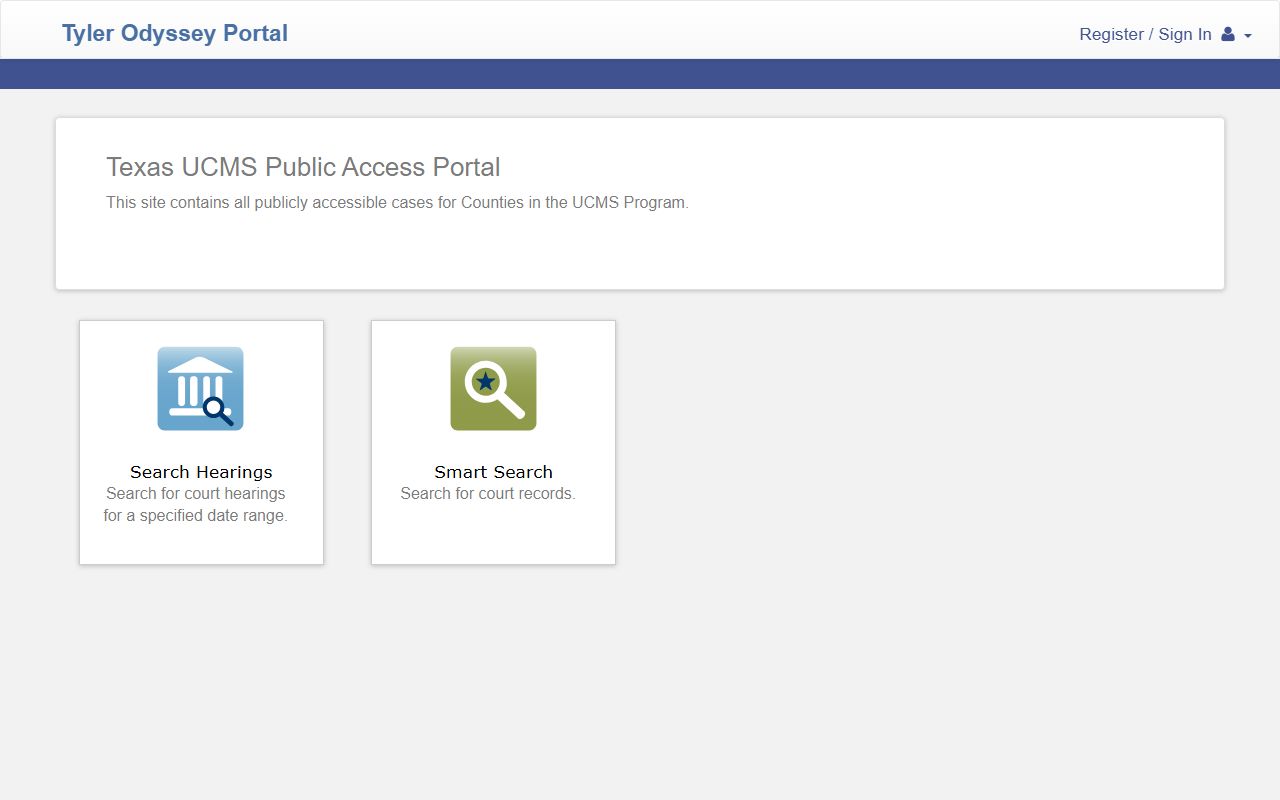
That portal is useful only after court filing. Same-day jail arrest information still needs the Jail Division, arresting agency, or written records route.
Colorado County Court Search Fields
Tyler Odyssey Smart Search is field-rich, which helps when a common name or partial case detail makes a Colorado County court records after arrest search broad. The system exposes party, case, judgment, and warrant filters. A booking number and SO number filter may appear in the court search interface, but those fields do not turn the portal into a jail roster. They help find filed court records tied to a person or case.
| Field | Type | Required | Use |
|---|---|---|---|
| Search Criteria | Text | Yes | Enter record number or name in Last, First Middle Suffix format. |
| Include | Checkboxes | No | Cases, Judgments, and Warrants can be included. |
| Search by | Option | No | Party Name, Nickname, Business Name, or Sounds Like. |
| Case Status | Filter | No | Narrows pending, closed, or other status groups if available. |
| File Date Start/End | Date | No | Helps isolate charges filed after a known arrest date. |
| Warrant Type/Status | Filter | No | Searches warrant records tied to the case or party. |
| Booking Number | Text | No | Shown as a party search filter, not as a public jail profile. |
The separate Search Hearings page can filter by Colorado County location, hearing type, case number, party name, attorney name, attorney bar number, judicial officer, courtroom, and date range. It is a hearing search, not a booking-photo or custody search.
Charges Filed After Arrest
Charging documents are the bridge between the jail arrest and the court record. Texas practice can involve a complaint, information, or indictment depending on the charge and stage of prosecution. In Colorado County, the prosecutor reviews arrest and offense material before deciding whether to file, amend, reduce, dismiss, or present a charge to a grand jury. A filed charge is still an accusation until a plea, verdict, dismissal, or other disposition resolves it.
| Document | Who Uses It | Common Role | What to Check |
|---|---|---|---|
| Complaint | Officer or prosecutor | Starts or supports a criminal accusation and probable-cause review. | Named offense, date, agency, and sworn facts if visible. |
| Information | Prosecutor | Formal prosecutor charging document in many non-indictment contexts. | Charge level, statute, count number, and filed date. |
| Indictment | Grand jury | Formal felony charging document after grand-jury action. | Counts, alleged offense dates, and later amendments. |
These documents may not match the first booking label word for word. The court record controls the formal charge path. The jail record helps explain custody, booking, bond, and release status.
Colorado County Charge Status
Charge status changes as a case moves through court. A Colorado County court record after an arrest may show a pending case, a warrant entry, a judgment, or a disposition. Prosecutor review can also change the case before it reaches judgment. For that reason, a searcher should read each count separately, not just the first offense line returned in a search result.
| Status | Meaning | Search Note |
|---|---|---|
| Pending | The charge is unresolved and remains before the court. | Check hearings and bond conditions. |
| Amended | The filed charge or count has been changed. | Compare the amended filing to the original count. |
| Reduced | The charge level or offense was lowered. | Look for a later plea, order, or judgment. |
| Dismissed | The court case is not proceeding on that charge. | Dismissal is not the same thing as automatic expunction. |
| Convicted | A plea or verdict resulted in a final finding or adjudication. | Read judgment terms, sentence, and supervision notes. |
Bond After Colorado County Arrest
Bond is often set or reviewed after the arrest under Texas criminal procedure. Code of Criminal Procedure Article 15.17 requires an arrested person to be taken before a magistrate without unnecessary delay. That stage can include warnings, rights, charge information, and release-condition decisions. Code of Criminal Procedure Chapter 17 is the central Texas bail chapter.
| Bond Type | How It Works | Colorado County Checkpoint |
|---|---|---|
| Cash bond | Money is paid as security for appearance. | Confirm accepted methods with the jail or court. |
| Surety bond | A licensed bonding company or surety posts bond. | Confirm the jail will accept it for that charge. |
| Personal or PR bond | Release is based on a written promise and conditions. | Check the case order for conditions. |
| No-bond hold | Ordinary bond is not available until cleared. | Ask whether a warrant, parole, federal, ICE, or other hold exists. |
Colorado County Warrants After Arrest
No separate official Colorado County sheriff active-warrant search page was located. Warrant searching is tied to the court-record portal, where Smart Search exposes an Include option for Warrants and filters for warrant type, warrant status, and warrant issued dates. A warrant may lead to jail booking when a person is arrested and committed to the county jail. Bench warrants can also issue after a missed court date or violation of a court order.
Lower-court bench warrants can be missed if only felony or district records are searched. Justice of the Peace and municipal court questions may require direct court contact. The sheriff's records procedure also says incidents or arrests inside Columbus, Eagle Lake, or Weimar city limits, or handled by DPS, should be routed to that agency for related police records.
Note: Do not go to the jail or courthouse based only on a web search if an active warrant may exist; confirm the proper court or agency first.
Charges, Convictions, Sealed Records
Two legal distinctions prevent many mistaken readings of Colorado County court records after a jail arrest. First, a charge is an accusation, while a conviction is a final court result. Second, a sealed or restricted record is not the same as an expunged record. Texas expunction law is addressed in Code of Criminal Procedure Chapter 55A, and the Colorado County District Clerk describes expunction as the legal process for removal and destruction of arrest and court records when eligibility exists.
| Issue | First Term | Second Term |
|---|---|---|
| Charge vs. conviction | A charge is the filed accusation and may be pending, amended, reduced, or dismissed. | A conviction follows a plea, verdict, or adjudication and is reflected in judgment records. |
| Sealed vs. expunged | A sealed or restricted record may be hidden from ordinary public view but can still exist for some purposes. | An expunction is a court-ordered removal or destruction process for eligible arrest and court records. |
The Colorado County District Clerk cautions that expunction eligibility is not automatic and depends on the specific arrest and case circumstances. A dismissal alone should not be read as proof that public records have been cleared.
Restricted Colorado County Court Records
Texas public-records law starts from access, but it also allows exceptions. Texas Government Code Chapter 552, the Public Information Act, applies to county and sheriff records. The Attorney General's open-government guidance notes that law-enforcement records tied to pending cases may be treated differently from basic information. Juvenile matters, sealed cases, expunction orders, sensitive data, and ongoing investigations can also affect what appears online.
The local rule is to use the system that holds the record. Jail arrest and booking material starts with the Sheriff's Office or arresting city/DPS agency. Filed criminal cases start with the Tyler Odyssey link, County Clerk, District Clerk, or court terminals. State prisoners move to TDCJ systems, while federal and immigration custody are separate from Colorado County court records after arrest.
Important: Public case lookups are not FCRA consumer reports and should not be used for employment, tenant, credit, insurance, or similar regulated screening.